
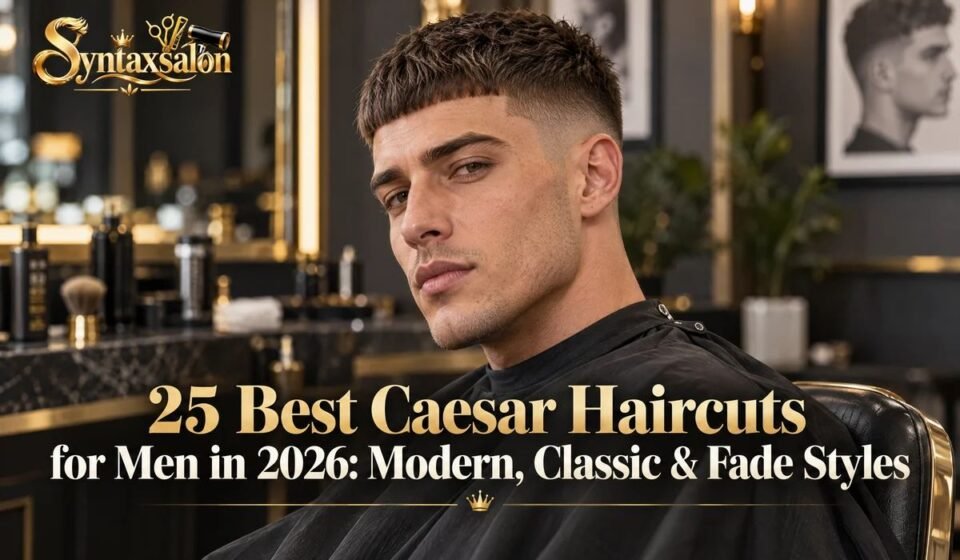

You show your barber a photo, say “short with a fringe,” and leave with something that looks nothing like it. Short cuts leave very little room for error. The right words matter more than the right photo.
This guide covers 25 Caesar haircuts for men, from no-fade classics to skin fades. Each style comes with a guard number and a word-for-word barber script. You’ll also find face shape matches, a comparison table, styling steps and trim timing.
Quick Answer: A Caesar cut is a short haircut with a straight, blunt fringe brushed forward. The sides can be even, tapered or faded, so a fade is optional. Caesar haircuts for men suit most hair types and usually need a trim every two to four weeks.
What Is a Caesar Haircut?
A Caesar haircut keeps the top at one even length and cuts the fringe straight across the forehead. The hair is then brushed forward. The top usually sits between half an inch and two inches, often around a #2 to #4 clipper guard. The sides can match the top, taper down or fade to skin.
Caesar haircuts for men all share that horizontal fringe. Everything else changes from style to style: fade height, texture and length. Because the hair is short and combed forward, most versions take about two minutes to style.
Where Did the Caesar Haircut Come From?
The name points to Julius Caesar. Roman busts show short hair combed forward, and a popular story says he liked it that way to manage thinning at the front. Treat that as a nice piece of history rather than a proven fact.
The cut came back in the 1990s, helped along by TV actors who wore it on screen. Caesar haircuts for men have stayed in barbershops ever since. Today the style mixes with fades, tapers and textured tops.
Is a Caesar Cut a Fade? Caesar With and Without Fade
No. “Caesar” describes the top: the short, blunt, forward fringe. “Fade” or “taper” describes the sides. Caesar haircuts for men can be worn with a fade, a taper or plain even sides.
Caesar Haircut No Fade
A no-fade Caesar keeps the sides at the same length as the top or tapers them gently into the neckline. It looks neat, grows out evenly and suits conservative workplaces. This is the easiest version to maintain between visits.
Caesar Fade Styles: Low, Mid, High and Skin
The fade level changes how bold the cut looks.
| Fade type | Where it starts | Look |
|---|---|---|
| Low fade | Just above the ear | Soft, subtle contrast |
| Mid fade | Around the temple | Clear contrast, very popular |
| High fade | Near the crown | Bold and sharp |
| Skin fade | Drops to bare skin | Cleanest, needs frequent trims |
20 Best Caesar Haircut Styles for Men
Each style lists the face shapes and hair types it suits, a script to read to your barber and a trim schedule. Guard numbers are rough guides. A #1 leaves about an eighth of an inch, and a #3 about three-eighths.
1. Classic Caesar Cut
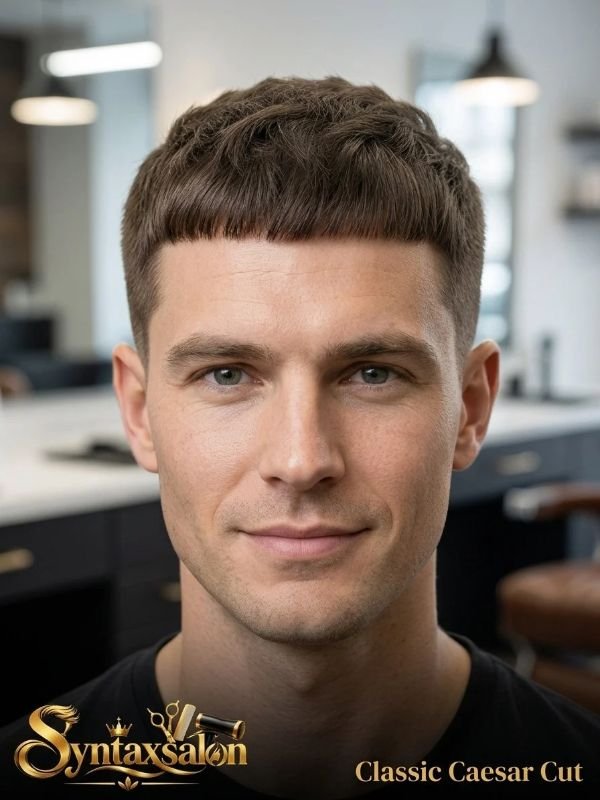
The original: even length on top, sides and back, with a blunt fringe at the hairline. There’s no fade and no sharp contrast. Because the length is uniform, it grows out evenly and buys you an extra week or two between cuts.
Best for: Oval and square faces. Straight or wavy hair.
Tell your barber: “Classic Caesar. #3 all over, straight fringe at the hairline, natural tapered neckline, no fade.”
Trim schedule: Every 3 to 4 weeks. ✂️
2. Modern Caesar with Low Fade
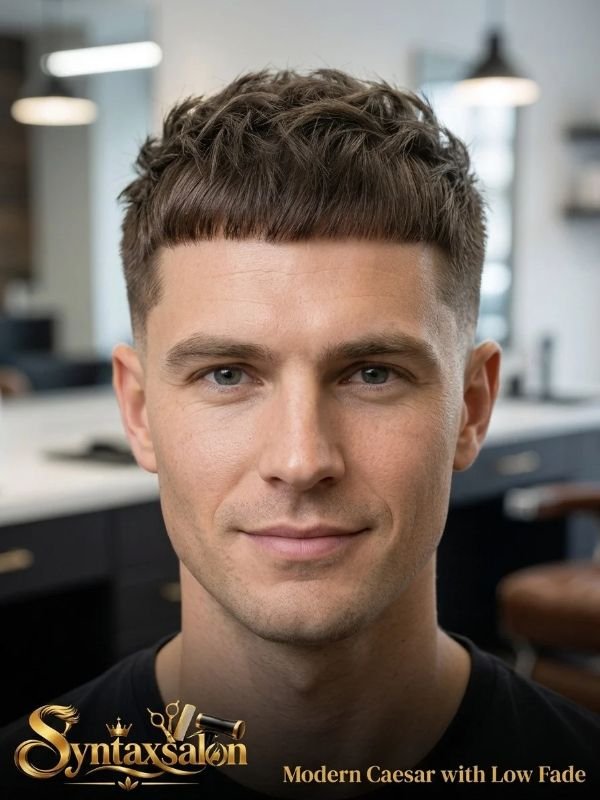
This version keeps the forward fringe and adds a low fade above the ears. The top carries a little more texture than the classic. Of all Caesar haircuts for men, this one bridges plain and polished best.
Best for: Most face shapes. Any hair texture.
Tell your barber: “Modern Caesar. Textured top, low fade starting above the ear, blunt fringe, clean blend on the sides.”
Trim schedule: Every 2 to 3 weeks. 😎
3. Textured Caesar Cut
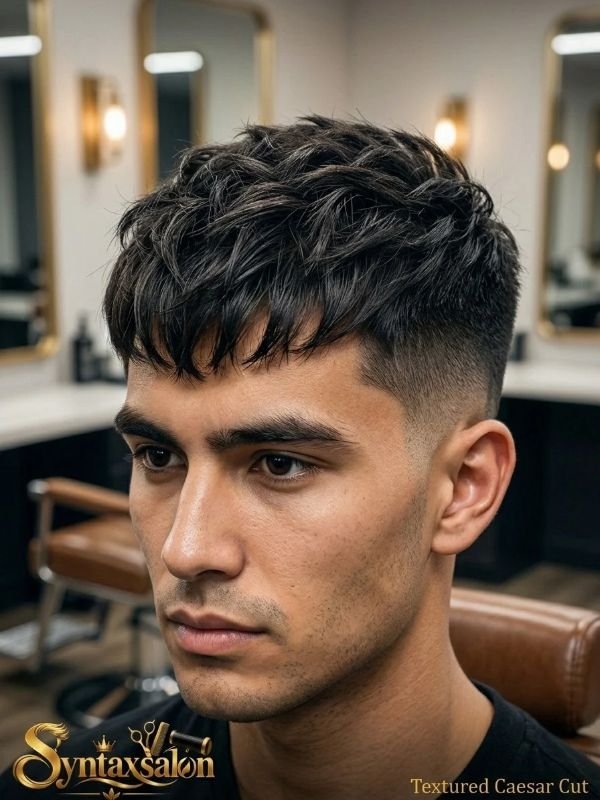
Point cutting breaks up the top so the strands separate and catch light. The fringe stays forward but its edge gets softer. Thick hair gains the most, because texturing removes bulk without losing coverage. A mid taper fade with textured fringe pairs well with this top.
Best for: Square and round faces. Thick or coarse hair.
Tell your barber: “Textured Caesar. Point cut the top, keep the fringe forward with softer edges, mid fade on the sides.”
Trim schedule: Every 2 to 3 weeks. 💈
4. Short Caesar Cut
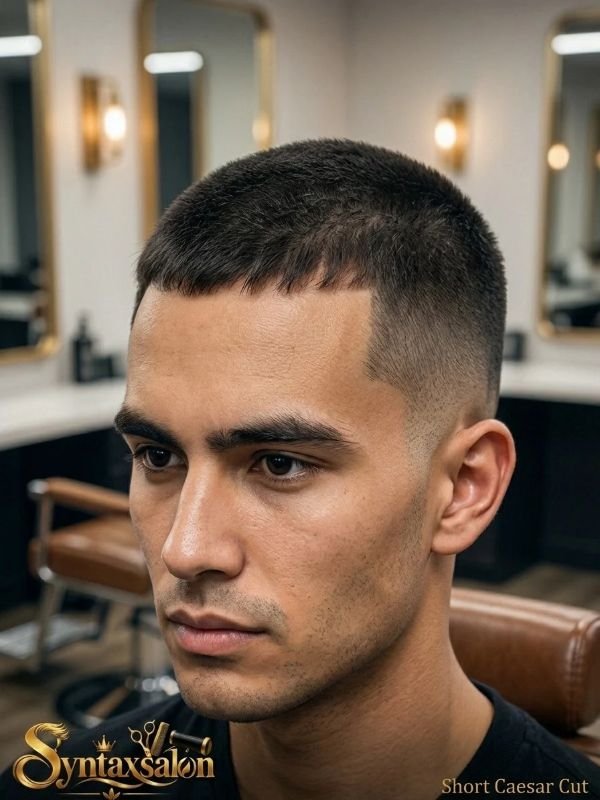
Take the top down to a #1 or #2 and the fringe becomes a subtle detail. Head shape matters more than face shape here, because the cut sits close to the scalp. It’s one of the lowest-maintenance variations.
Best for: Oval, diamond and heart faces. Fine or thin hair.
Tell your barber: “Short Caesar. #1 or #2 on top, fringe shaped at the hairline, tight taper or skin fade on the sides.”
Trim schedule: Every 2 weeks. ⚡
5. Long Caesar Cut
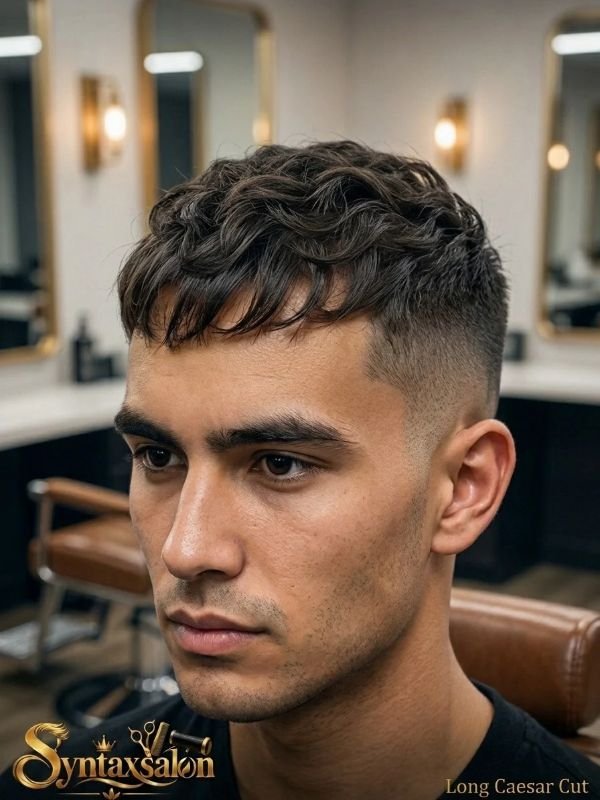
Leave two to three inches on top and the fringe can move and carry texture. The sides stay short, so the Caesar shape holds. It’s a good entry point if you want more styling options.
Best for: Oblong and rectangular faces. Wavy or straight hair of medium density.
Tell your barber: “Long Caesar. Leave two to three inches on top, fringe falls just past the hairline, low or mid fade on the sides.”
Trim schedule: Every 3 weeks. 💇♂️
6. Caesar Mid Fade
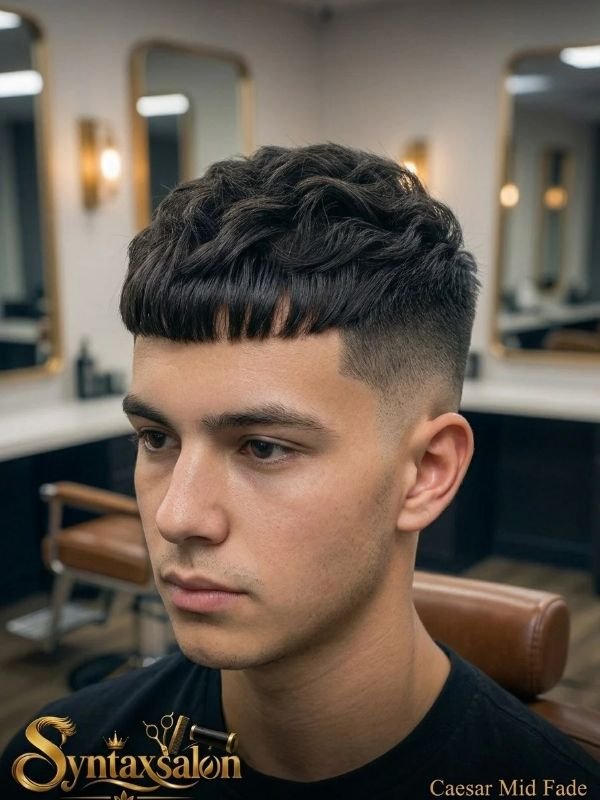
The fade begins at temple height, so the contrast with the fringe is stronger. The eye lands right where the fade meets the top. That’s why this cut photographs so well.
Best for: Round, square and diamond faces. Thick hair.
Tell your barber: “Caesar with a mid fade. Start the fade at the temple, #0.5 at the base, blend into a #3 on top.”
Trim schedule: Every 2 to 3 weeks. 📸
7. Caesar High Fade
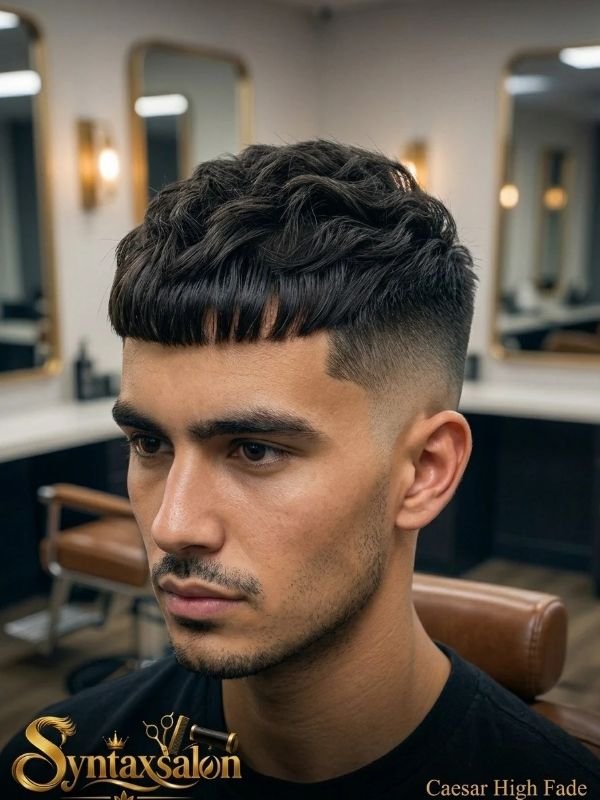
A high fade pushes the contrast as far as it goes. It starts near the crown and drops to skin quickly, which makes the top look taller. If you like the sharper look, our guide to the high fade haircut shows more fade options. Round faces often look better with a mid fade, since extra height at the sides can add width.
Best for: Square, rectangular and diamond faces. Dense hair.
Tell your barber: “Caesar with a high fade. Start near the crown, take it to skin at the temples, keep the fringe sharp.”
Trim schedule: Every 2 weeks. 🚀
8. Caesar Skin Fade
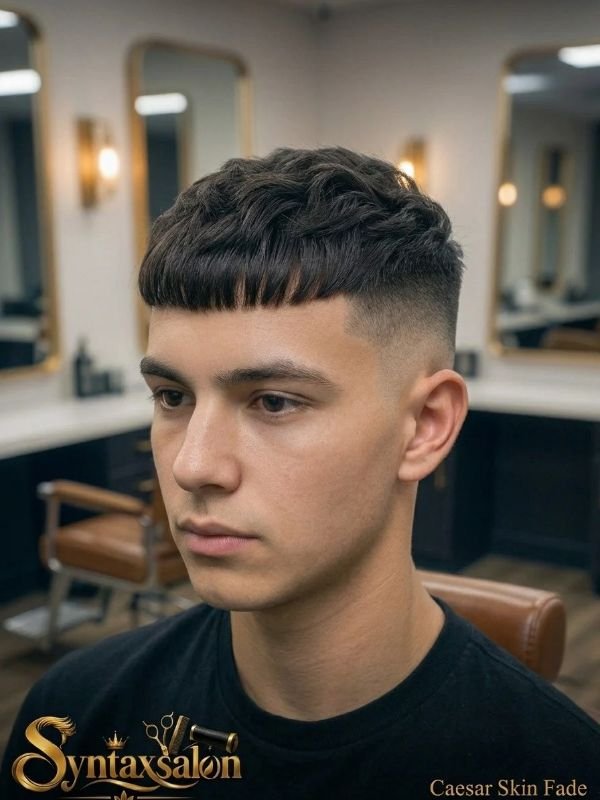
The sides go down to bare skin, finished with a razor. The blend between skin and top needs a steady hand. A rushed blend leaves a visible line.
Best for: Oval and heart faces. All hair textures.
Tell your barber: “Caesar with a skin fade. Razor the sides to skin, blend into the top with no hard line, keep the fringe straight.”
Trim schedule: Every 2 weeks. 🪒
9. Caesar Taper
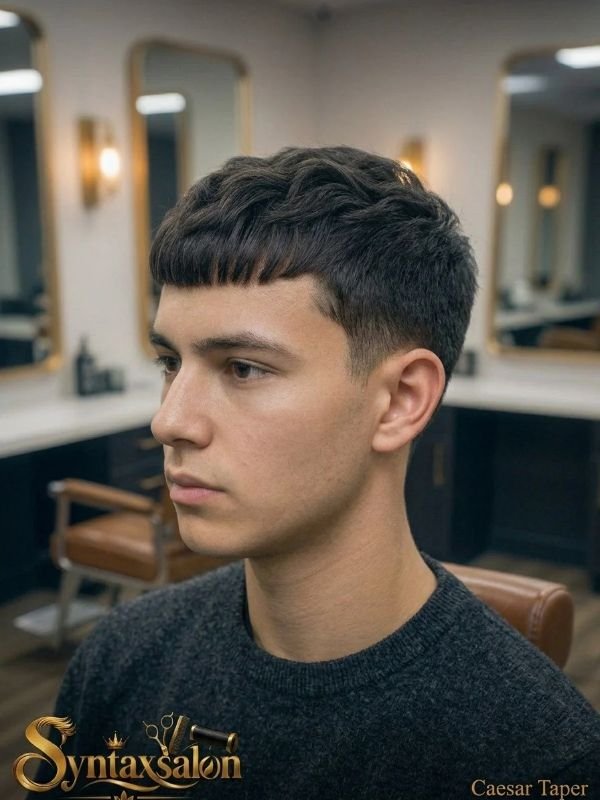
A taper shortens the sides gradually, without a fade’s defined gradient. It looks softer and more traditional. It also grows out better than most faded styles. Men with straight hair can find more ideas in our guide to low taper fade styles for straight hair.
Best for: Oblong, heart and oval faces. Straight or wavy hair.
Tell your barber: “Caesar with a taper, not a fade. Shorten the sides gradually, natural neckline, blunt fringe.”
Trim schedule: Every 3 to 4 weeks. 👔
10. Caesar Drop Fade
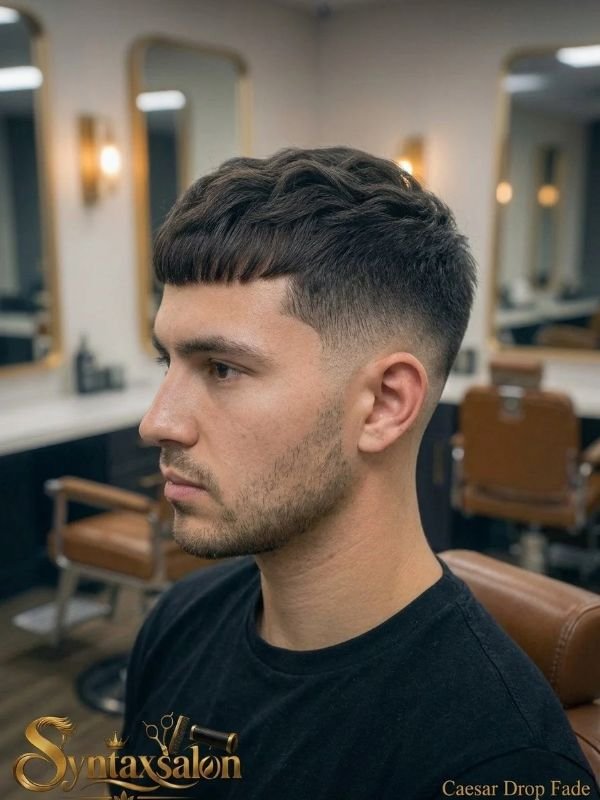
The fade line follows the curve of the ear. It sits higher at the temple and drops lower behind the ear. That arc gives the side profile extra shape, especially from a three-quarter angle.
Best for: Round, oval and heart faces. All hair textures.
Tell your barber: “Caesar on top with a drop fade. Let the fade curve down behind the ear instead of running straight across.”
Trim schedule: Every 2 to 3 weeks. 🌀
11. Caesar Buzz Cut
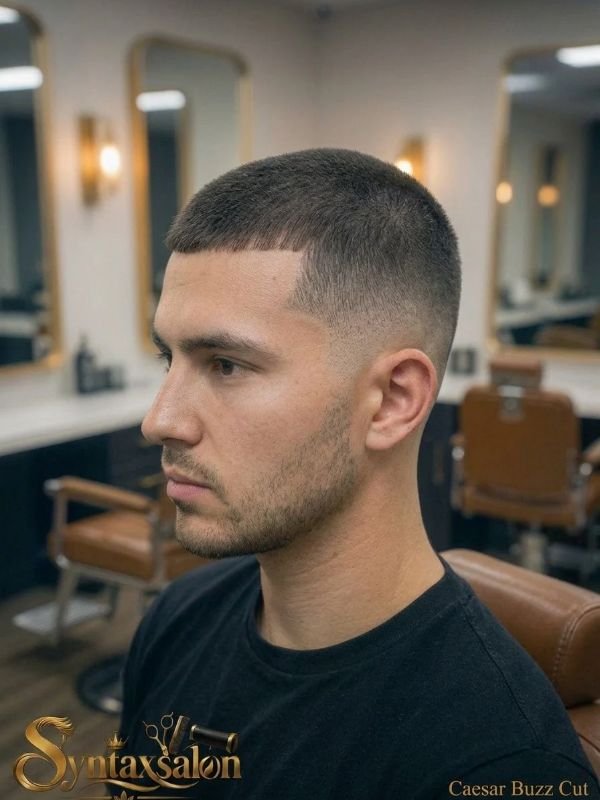
This is the shortest Caesar before it stops being one. The top sits at a #1 with just enough grain direction to show the forward fringe. Among Caesar haircuts for men, the buzz is the easiest to touch up at home with clippers.
Best for: Strong jawlines and angular features. Fine, thin or tightly coiled hair.
Tell your barber: “Buzz Caesar. #1 on top, #0 or #1 on the sides, fringe direction forward, lined up at the hairline.”
Trim schedule: Every 2 weeks. 💪
12. Messy Caesar Cut
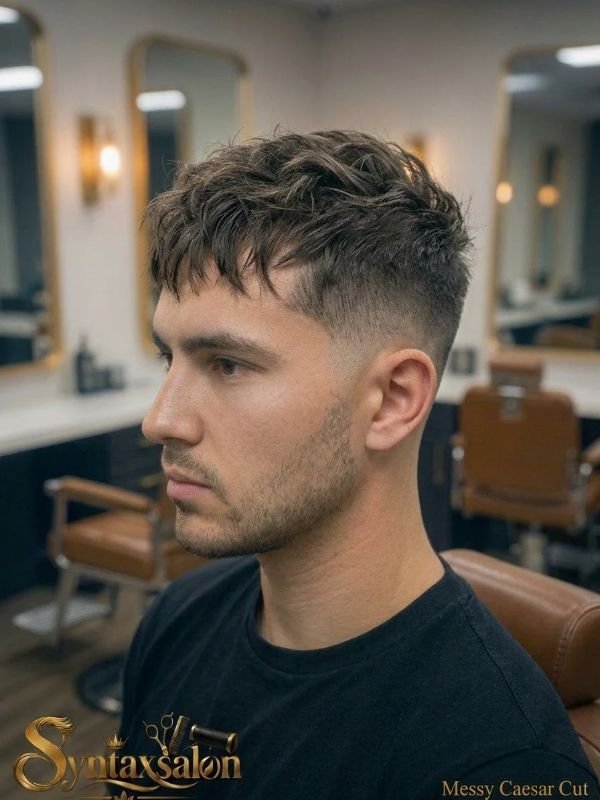
Here the top gets finger-styled rather than combed. The fringe falls forward with a little intentional unevenness. Sea salt spray does the work, not pomade. Wavy hair cooperates naturally, while straight hair needs a bit more product.
Best for: Oval, diamond and heart faces. Wavy or naturally textured hair.
Tell your barber: “Messy Caesar. Keep the fringe slightly uneven, point cut the top for texture, low or mid fade.”
Trim schedule: Every 3 weeks. 🌬️
13. Curly Caesar Cut
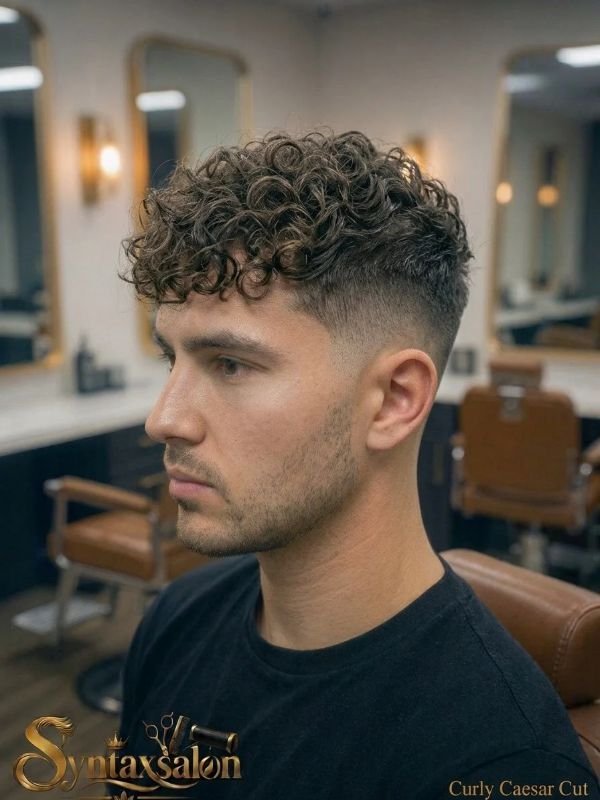
Curls and a forward fringe work well together. The curl pattern adds volume that straight hair needs product to fake. Ask your barber to cut it dry so they can see the real curl length. Curly hair springs up as it dries, so leave more length than you think you need. For the shorter end of this look, see our take on buzz cut curly hair.
Best for: Oval, round and heart faces. Curly or wavy hair of medium to thick density.
Tell your barber: “Curly Caesar. Cut it dry, leave extra length for curl spring, tight fade on the sides, don’t thin out the top.”
Trim schedule: Every 3 weeks. 🧴
14. Wavy Caesar Cut
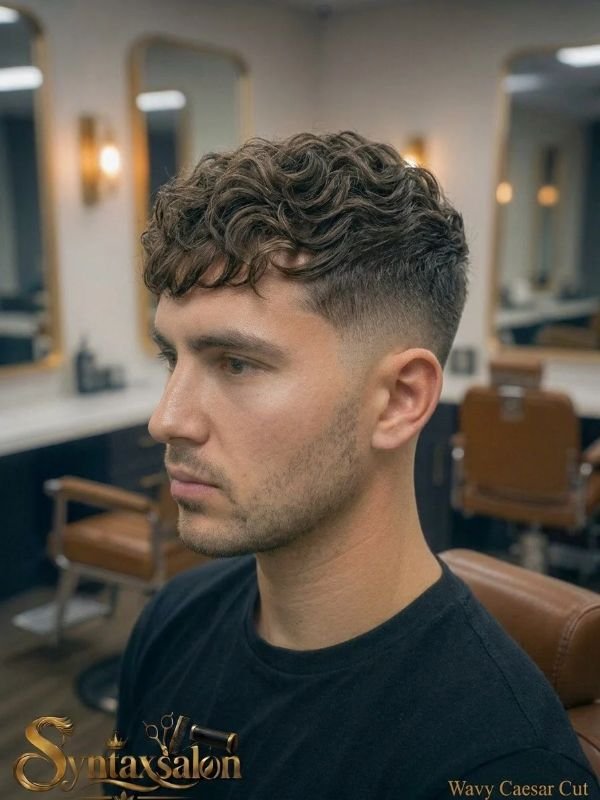
Waves give the Caesar a softer, more editorial feel. The fringe won’t sit ruler-straight, and that’s the charm. Blow-dry forward while guiding the hair with your fingers.
Best for: Oval, square and oblong faces. Naturally wavy hair.
Tell your barber: “Wavy Caesar. Don’t fight the wave pattern. Keep about two inches on top, taper or low fade on the sides.”
Trim schedule: Every 3 weeks. 🌊
15. Caesar for Receding Hairline
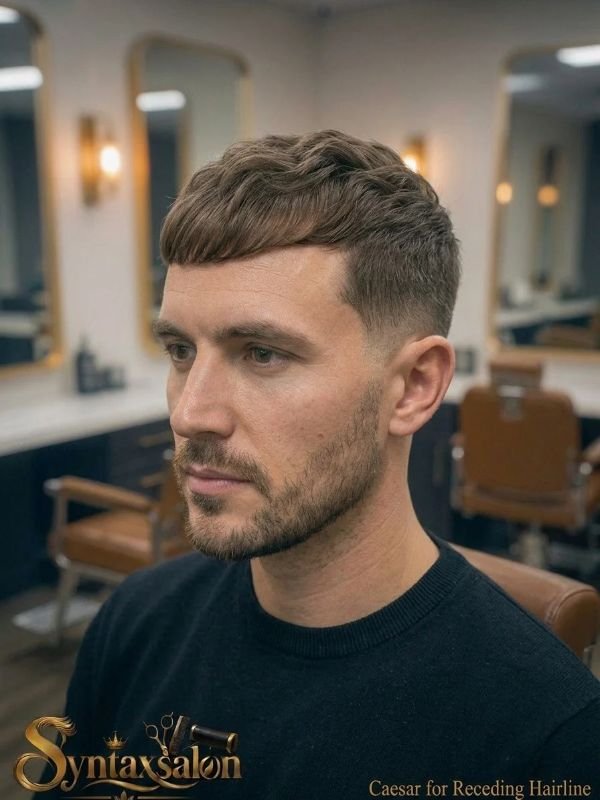
This variation uses the forward fringe to soften temple recession. It works as styling, not as a treatment. Keep the fringe blunt and forward, keep the sides tight, and skip a sharp line-up at the front. A hard line draws the eye to the hairline.
Best for: Men with temple recession. Straight, wavy or fine hair.
Tell your barber: “Caesar for a receding hairline. Bring the fringe forward over the temples, no hard line-up at the front, tight taper on the sides, keep it soft.”
Trim schedule: Every 2 to 3 weeks. 🎯
16. Caesar Undercut
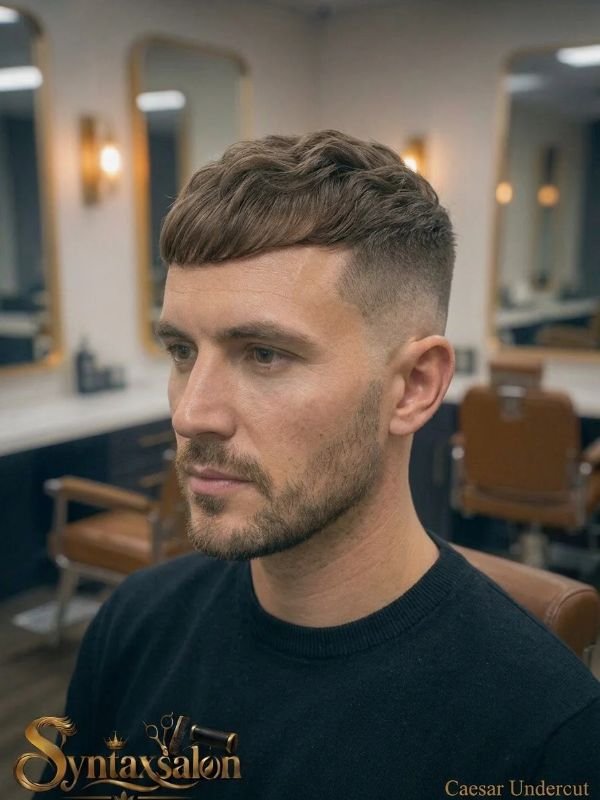
An undercut creates a clean break between the top and the very short sides. There’s no gradual blend. The break makes the fringe look heavier and the sides look sharper. It takes some confidence to wear.
Best for: Square, diamond and angular faces. Thick, straight or wavy hair.
Tell your barber: “Caesar undercut. Disconnect the top from the sides with no blend, #1 on the sides, blunt forward fringe.”
Trim schedule: Every 2 to 3 weeks. ⚔️
17. Caesar Mullet
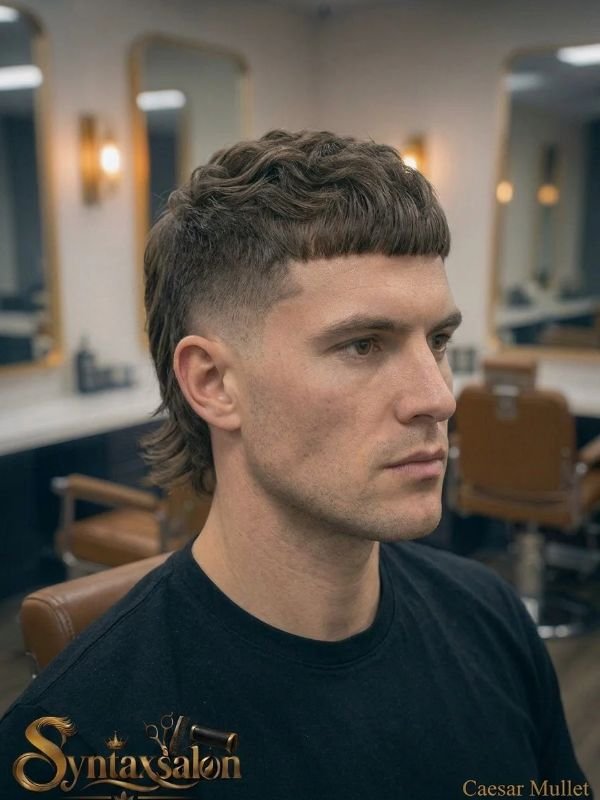
The front is pure Caesar: short, blunt, forward. The back grows past the collar in layers. The structured front keeps the length at the back looking deliberate. For fade ideas in this style, check the modern mullet fade guide.
Best for: Oval, heart and diamond faces. Wavy or straight hair of medium density.
Tell your barber: “Caesar mullet. Blunt fringe, mid fade on the sides, let the back grow past the collar, add layers for movement.”
Trim schedule: Front every 2 to 3 weeks. Back every 4 to 6 weeks. 🎸
18. Dark Caesar (Black Men)
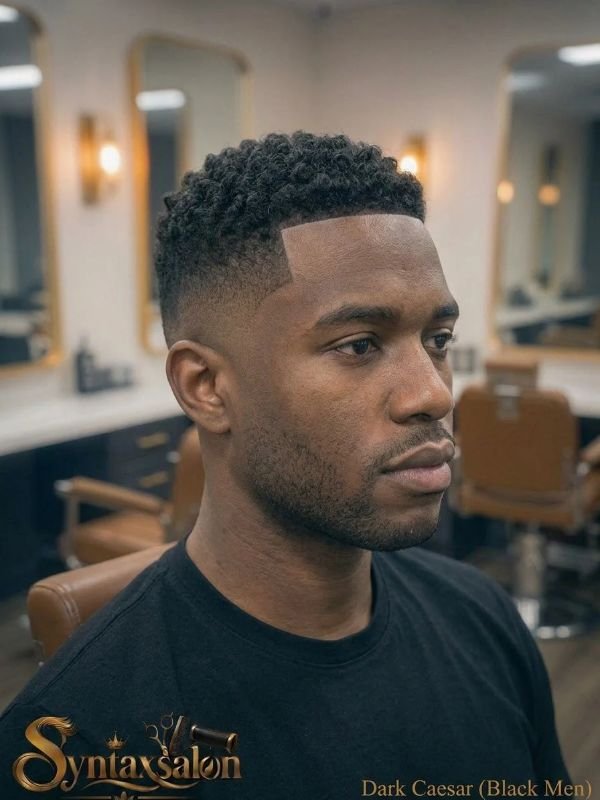
Built for coily and tightly curled hair, this version keeps the top at a #1 or #2 and often adds a skin fade. The crisp line-up at the forehead and temples frames the face. A boar bristle brush helps keep the hair direction between visits. For more fade ideas, see our guide to low fade haircuts for Black men.
Best for: All face shapes. Coily and tightly curled hair.
Tell your barber: “Dark Caesar. #1 or #2 on top, skin fade on the sides, sharp line-up at the forehead and temples.”
Trim schedule: Line-up every 2 weeks. Full cut every 2 to 3 weeks. 🖤
19. Caesar with Beard
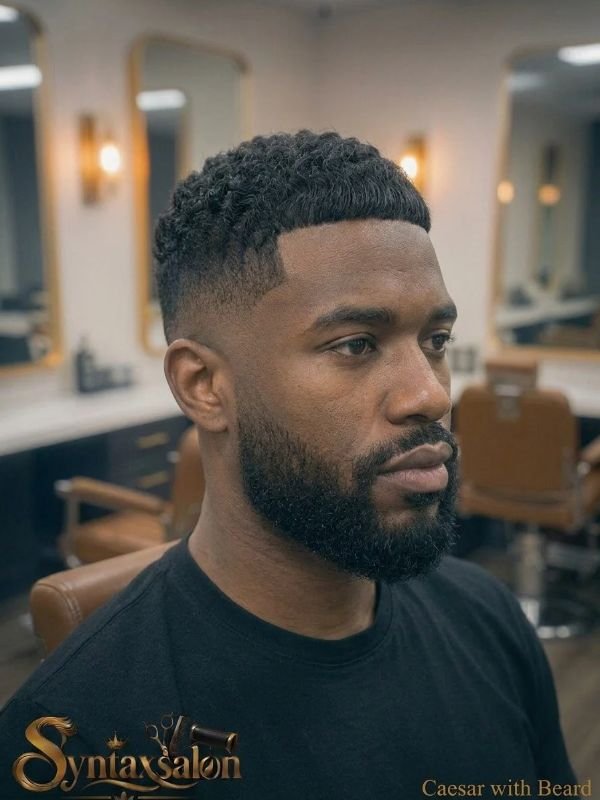
The short fringe up top and the beard below frame the face. Proportion matters. A short Caesar with a full beard feels balanced. A long Caesar with a long beard can look unkempt. Keep both on a similar schedule.
Best for: Square, round and oblong faces. Men with full, even beard growth.
Tell your barber: “Caesar on top with a mid fade, blend the fade into the beard line, keep the fringe blunt, line up the beard at the cheeks.”
Trim schedule: Haircut every 2 to 3 weeks. Beard trim every 1 to 2 weeks. 🧔
20. Layered Caesar Cut
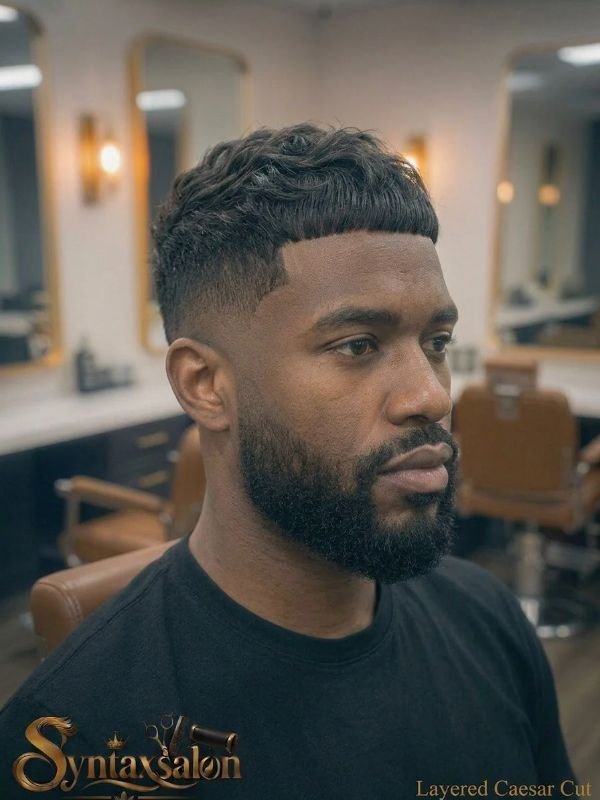
Soft internal layers give flat or fine hair extra lift without adding length. The fringe stays blunt, but the hair behind it sits at slightly different heights. A light dusting of texture powder at the roots brings the layers to life.
Best for: Oblong, oval and heart faces. Fine, thin or flat-lying hair.
Tell your barber: “Layered Caesar. Add soft layers through the top for volume, keep the fringe blunt, low fade or taper on the sides.”
Trim schedule: Every 3 weeks. 🪶
5 More Caesar Haircuts for Men Worth Asking For
These five round out the list and cover looks the first 20 skip.
21. Ivy League Caesar
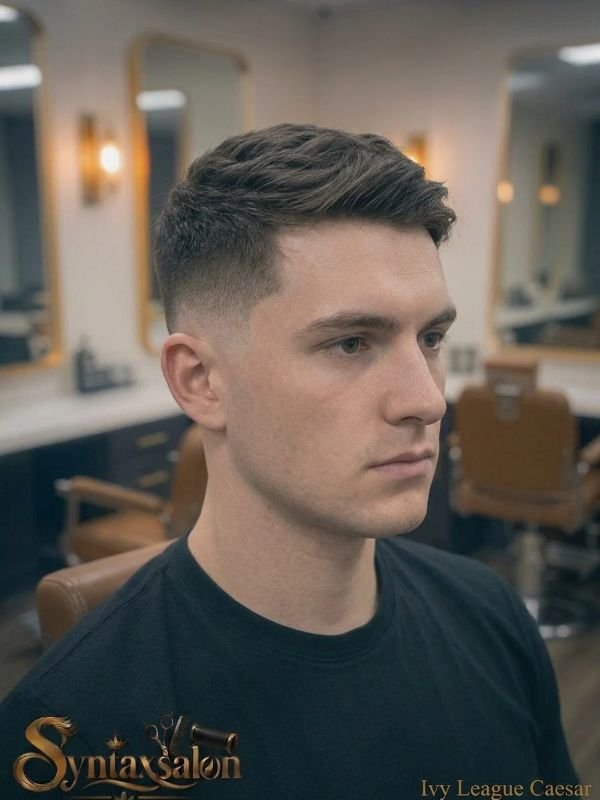
Take the Caesar fringe, add a bit more length on top and a slight side sweep. The result looks collegiate and tidy. It’s a good middle ground between a Caesar and a side part.
Best for: Oval and square faces. Straight hair.
Tell your barber: “Ivy League Caesar. Slightly longer top, fringe brushed forward with a light side sweep, tapered sides.”
Trim schedule: Every 3 weeks. 🎓
22. Mod Caesar Cut
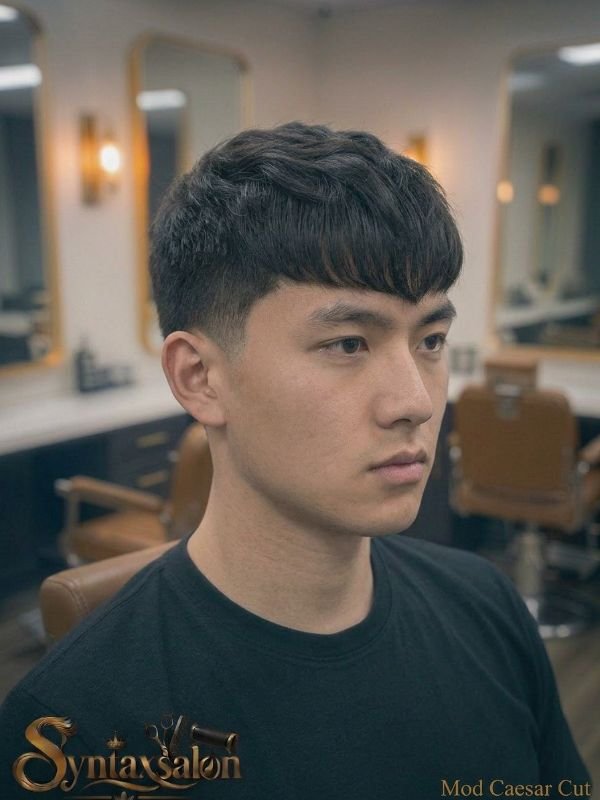
The mod look borrows from 1960s British style. The fringe is fuller and the top carries more weight than a standard Caesar. The sides stay tapered rather than faded hard.
Best for: Oval, square and heart faces. Medium to thick hair.
Tell your barber: “Mod Caesar. Full, even top around two inches, fringe forward with some body, taper the sides without a harsh fade.”
Trim schedule: Every 3 weeks. 🕶️
23. Box Fade Caesar
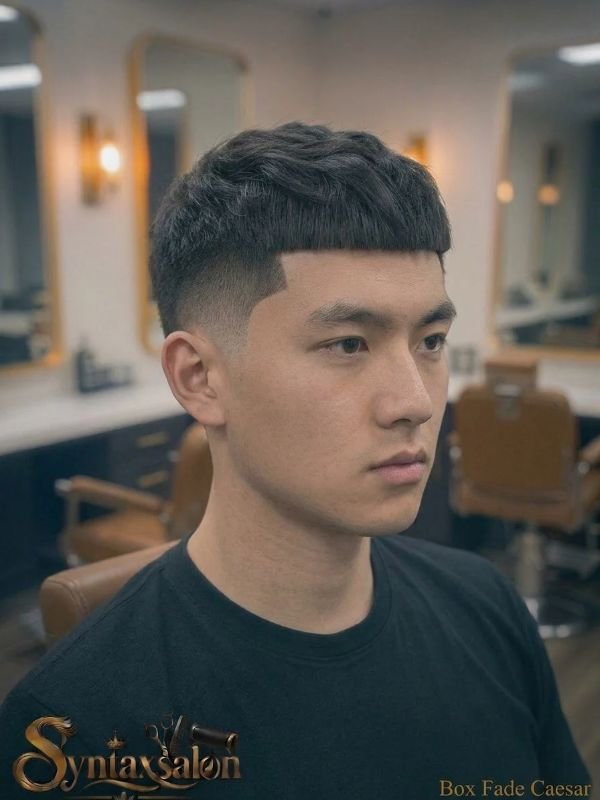
The box fade is about edges. The line-up around the hairline and temples is squared off and crisp. It pairs a fade with sharp geometry, so the fringe looks very deliberate.
Best for: Oval, square and diamond faces. All textures, especially coily.
Tell your barber: “Caesar with a box fade. Square off the hairline and temples, fade the sides clean, keep the fringe straight.”
Trim schedule: Every 2 weeks. 📐
24. Blonde Caesar Cut
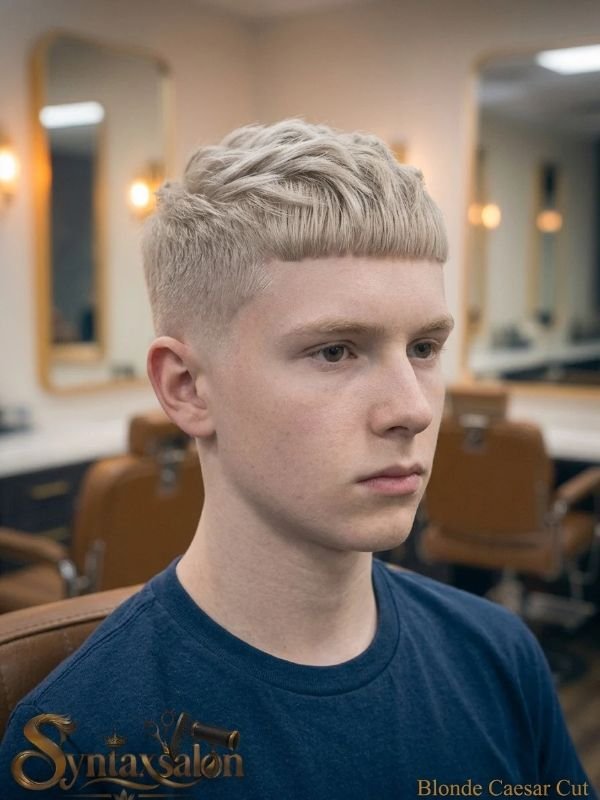
Bleached or colored hair shows texture and cut shape clearly. Bleaching can leave hair drier, so use a good conditioner and don’t over-style with heat. Ask a colorist how often you’ll need to touch up the roots.
Best for: Most face shapes. Straight or wavy hair that’s healthy enough to lighten.
Tell your barber: “Blonde Caesar. Textured top, blunt forward fringe, low taper on the sides. Keep the length easy to maintain with color.”
Trim schedule: Every 2 to 3 weeks. 🌟
25. Caesar with Temple Fade
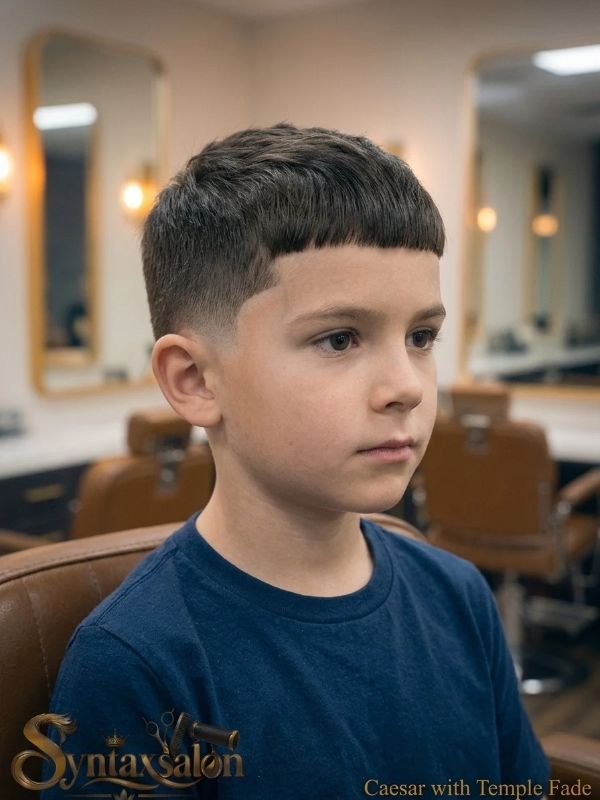
Only the temples get faded, while the rest of the sides taper. It keeps the frame around the face clean without the full contrast of a mid or high fade. It’s a good pick if you want sharpness with less upkeep.
Best for: Oval, round and diamond faces. All hair textures.
Tell your barber: “Caesar with a temple fade. Fade only the temples, taper the rest of the sides, keep the fringe blunt.”
Trim schedule: Every 2 to 3 weeks. 🧭
Quick Comparison: All 25 Caesar Styles at a Glance
These Caesar haircuts for men differ mostly in fade level, top length and upkeep. Use the table to narrow your shortlist.
| # | Style | Sides | Top length | Trim every |
|---|---|---|---|---|
| 1 | Classic | Even or tapered | Short | 3–4 weeks |
| 2 | Modern with Low Fade | Low fade | Short to medium | 2–3 weeks |
| 3 | Textured | Mid fade | Medium | 2–3 weeks |
| 4 | Short | Skin fade or tight taper | Very short | 2 weeks |
| 5 | Long | Low or mid fade | Long | 3 weeks |
| 6 | Mid Fade | Mid fade | Short to medium | 2–3 weeks |
| 7 | High Fade | High fade | Short | 2 weeks |
| 8 | Skin Fade | Skin | Short | 2 weeks |
| 9 | Taper | Taper | Short | 3–4 weeks |
| 10 | Drop Fade | Drop fade | Short to medium | 2–3 weeks |
| 11 | Buzz Cut | #0 or #1 | Very short | 2 weeks |
| 12 | Messy | Low or mid fade | Medium | 3 weeks |
| 13 | Curly | Tight fade | Medium | 3 weeks |
| 14 | Wavy | Taper or low fade | Medium | 3 weeks |
| 15 | Receding Hairline | Tight taper | Short to medium | 2–3 weeks |
| 16 | Undercut | Disconnected | Medium | 2–3 weeks |
| 17 | Mullet | Mid fade | Short front, long back | 2–3 weeks (front) |
| 18 | Dark Caesar | Skin fade | Very short | 2–3 weeks |
| 19 | With Beard | Mid fade | Short | 2–3 weeks |
| 20 | Layered | Low fade or taper | Medium | 3 weeks |
| 21 | Ivy League | Taper | Medium | 3 weeks |
| 22 | Mod | Taper | Medium to long | 3 weeks |
| 23 | Box Fade | Fade | Short | 2 weeks |
| 24 | Blonde | Taper or fade | Short to medium | 2–3 weeks |
| 25 | Temple Fade | Temple fade and taper | Short | 2–3 weeks |
How Do You Choose the Right Caesar Cut for Your Face Shape?
The fringe direction stays the same across Caesar haircuts for men. What changes is fade height, top length and texture. Match those to your bone structure and the cut sits more naturally. If you have a wide jaw and narrower forehead, our guide to triangle face shape hairstyles for men goes deeper.
| Face shape | Good picks | Why it works | Be careful with |
|---|---|---|---|
| Oval | Almost any | Balanced proportions suit most lengths | Nothing major |
| Round | Mid fade, textured Caesar | Height on top and tighter sides add length | Even-length classic with full sides |
| Square | Classic, taper | The blunt fringe echoes a strong jaw | Very short buzz can feel stark |
| Oblong | Long, layered | The fringe shortens the look of the face | High fade, which adds height |
| Heart | Low fade, messy | A soft fringe balances a wider forehead | Undercut, which highlights forehead width |
| Diamond | Mid fade, textured | Adds balance around the cheekbones | Flat, uniform length |
| Triangle | Textured Caesar, taper | Volume on top balances a wider jaw | Very tight sides with a flat top |
By Hair Type
Most Caesar haircuts for men work on every texture, but the product and technique change.
- Straight hair: Classic, taper or short Caesars fall flat and forward. Use matte clay or a light pomade.
- Wavy hair: Messy, wavy or textured versions use your natural pattern. Sea salt spray helps.
- Curly hair: Go for the curly Caesar and cut it dry. Curl cream keeps the shape.
- Coily hair: The dark Caesar with a skin fade and line-up works well. A light oil helps with scalp comfort.
- Fine or thin hair: Short or layered versions look fuller. Texture powder adds lift, and shiny products make thin hair look flatter.
- Thick hair: Point cutting removes bulk and a mid or high fade controls width at the sides.
Caesar vs French Crop vs Crew Cut: What’s the Real Difference?
People mix these three up all the time. The fringe is the easiest way to tell them apart. A Caesar has a short, blunt fringe, a French crop has a longer and choppier one, and a crew cut has no real fringe at all. If you like the crop, our French crop taper fade haircut guide shows how it looks with a taper.
| Feature | Caesar | French crop | Crew cut |
|---|---|---|---|
| Fringe | Short, blunt, straight across | Longer, choppy, textured | None |
| Top length | Even, short | Slightly longer, graduated | Short, longer toward the front |
| Direction | Forward | Forward | Upward or back |
| Sides | Even, tapered or faded | Usually faded | Tapered or faded |
| Styling | Brush forward | Texture product | Finger-style or comb |
| Hairline coverage | Good | Moderate | Limited |
What Should You Tell Your Barber for a Caesar Cut?
Give your barber three details: the top length as a guard number, the side treatment as a fade level or taper, and the fringe style as blunt or textured. A common mix-up at the chair is saying “short on top” with no number. The barber then picks a length for you.
Here are scripts you can use as they are:
- Classic: “#3 on top, even all around, straight fringe, tapered neckline, no fade.”
- Modern with fade: “Caesar top at a #3 or #4, blunt fringe forward, low fade on the sides blended clean, tapered neckline.”
- Textured: “Point cut the top, keep the fringe forward but slightly uneven, mid fade on the sides.”
- Softer hairline: “Bring the fringe forward over the temples, no hard line-up in front, tight taper on the sides.”
Bring photos from the front, side and back. Fringe angle and fade height are hard to explain in words.
How Do You Style a Caesar Haircut at Home?
Most versions take about two minutes. The shorter the cut, the less you need.
- Short, classic or buzz: Towel-dry, rub a pea-sized amount of matte clay through your hands and brush the hair forward.
- Long, wavy or textured: Spray sea salt spray into damp roots, blow-dry forward on medium heat and shape with your fingers. Finish with a little clay.
- Curly or coily: Apply curl cream or a light oil to damp hair, then air-dry or use a diffuser. Brushing and blow-drying can flatten curl definition.
- Layered or thin hair: Tap texture powder into the roots first, then follow the short routine.
How Often Should You Trim a Caesar Cut?
Most Caesar haircuts for men need a visit every two to three weeks. Faded versions sit at the shorter end. Tapered versions can stretch toward four weeks.
Here’s what usually happens week by week:
- Weeks 1 to 2: Lines are sharpest and the contrast is strongest.
- Week 3: The sides lose some definition and the fringe sits a little lower. This is a good time to rebook.
- Weeks 4 to 5: Faded sides blur and longer fringes can fall into your eyes. Tapers hold their shape better.
- Week 6 and beyond: The cut has grown into something else.
How Much Does a Caesar Haircut Cost?
Prices for Caesar haircuts for men vary a lot by country, city and shop type. A fade, a line-up or a beard trim usually adds to the base price. Independent barbershops often charge more than quick-service chains, but they tend to spend longer on the blend.
Ask for the price before you sit down. If you’d like to save money, the buzz and short versions are the most beginner-friendly to do at home with clippers. Leave anything with a fade to a barber.
What Are the Best Products for a Caesar Cut?
Caesar haircuts for men work best with light, matte products. Heavy gels and high-shine pomades fight the clean shape.
- Matte clay: The everyday pick. It holds the fringe without a wet look.
- Sea salt spray: Adds grip and texture for messy, wavy or textured versions.
- Pomade: Gives a polished, slightly shiny finish. Use very little.
- Texture powder: Adds lift at the roots for thin or fine hair.
- Styling cream: Gives soft hold and movement for waves and curls.
- Light oil: Helps with scalp comfort and shine on coily hair. A few drops go a long way.
Wash your hair regularly so product doesn’t build up on the scalp.
Can a Caesar Cut Hide a Receding Hairline? What It Can and Can’t Do
A Caesar can soften the look of temple recession. The forward fringe covers the corners where the hairline has moved back. That’s a styling effect only. Caesar haircuts for men don’t treat hair loss or slow it down.
If you notice sudden, patchy or fast hair loss, see a doctor or dermatologist. A haircut won’t tell you why it’s happening. Meanwhile, a short, soft cut without a hard front line is a practical choice.
Frequently Asked Questions
Is a Caesar Haircut Professional Enough for the Office?
Yes. Classic and tapered versions look neat and work in most offices. Skin fades and bold undercuts can feel more casual in conservative workplaces.
Can I Cut a Caesar Haircut at Home?
The buzz and short versions are doable with clippers and a mirror, because even length hides small mistakes. Fades and neckline finishes are much harder to get right alone.
What’s the Minimum Hair Length Needed for a Caesar?
About half an inch, roughly a #4 guard on top. Shorter than that and the fringe won’t lie forward, so it becomes a buzz cut.
Can a Caesar Work on Thick, Coarse Hair?
Yes. Thick hair holds the blunt shape well. Ask for point cutting to remove bulk and a mid or high fade to control width at the sides.
How Is a Caesar Different from a Textured Crop?
A Caesar fringe is blunt and cut in a clean straight line. A textured crop has a choppier, longer fringe with visible separation. Both are short and forward-facing.
Should I Get a Caesar If My Hair Is Thinning at the Crown?
A short Caesar with texture powder can make crown thinning less noticeable, since the hair moves forward. Skip long versions because extra length can split and show more scalp. If thinning worries you, a doctor can check the cause.
Does the Caesar Suit Curly Hair?
Yes. Curls add natural volume and the forward fringe works with the pattern. Ask for a dry cut so your barber sees the true curl length, and use a curl cream for definition.
Conclusion
A Caesar cut is defined by its blunt, forward fringe. Everything else is your call: fade or no fade, short or long, sleek or messy. Pick the version that fits your face shape, hair type and how often you’ll visit the barber.
Walk in with a photo and a guard number, and you’ll leave with the cut you meant to ask for. If you want to explore related looks, try a high fade haircut or a textured top next.