
Every haircut hides a dozen tiny decisions. How high should the fade start? How long should the front stay? Will it still look right on day three? If you’ve ever walked out of the chair with something close to your photo but not quite, you know how much those details matter.
This guide covers the cut from both sides of the chair. You’ll learn how it differs from a mid fade, what to tell your barber, which hair types and products work best, and how to keep it sharp between visits.
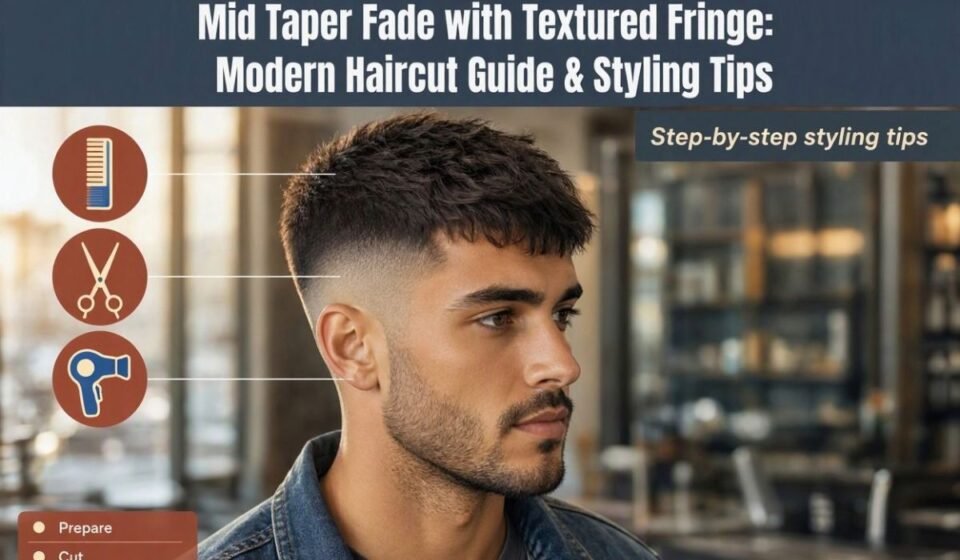
Quick Answer: A mid taper fade with textured fringe keeps the sides short and neatly blended from around the temple down, while the top stays longer, choppy and pushed forward. Ask your barber for a mid taper, name the shortest finish you want (shadow or skin), and request point-cutting on top for texture. Style it with a matte clay or paste on hair that’s dried mostly dry.
Introduction to Mid Taper Fade with Textured Fringe
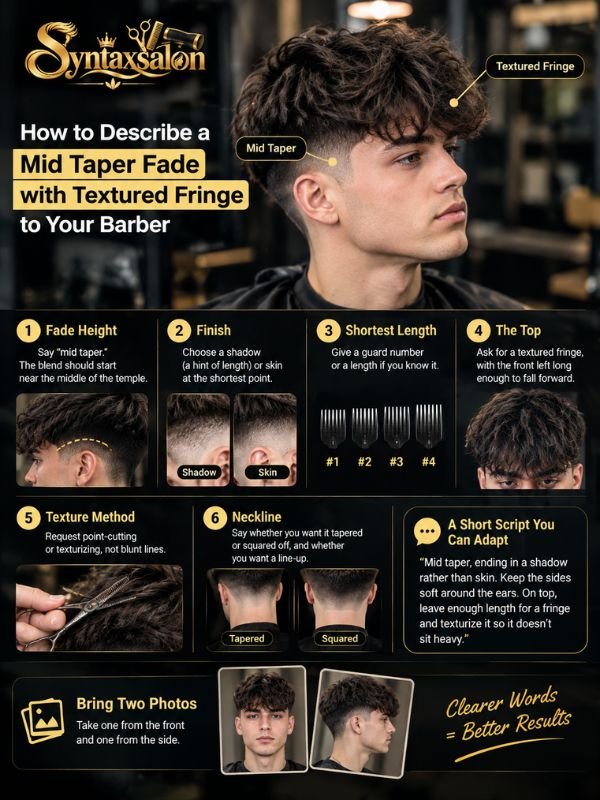
This cut pairs two simple ideas. On the sides, the hair tapers: it gets gradually shorter from around the middle of the temple, blending mainly through the sideburns and neckline. On top, the hair stays longer and gets cut with texture, so the front falls forward in loose, uneven pieces.
That’s what makes a mid taper fade with textured fringe work. The sides look clean and framed. The top looks relaxed and a little undone. Together they read as polished without trying too hard.
Mid Taper vs Mid Fade
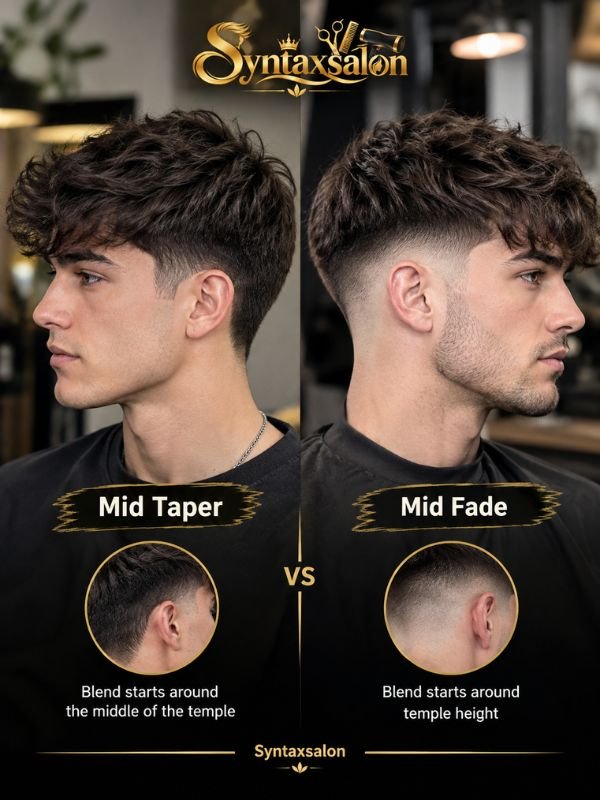
People mix these up all the time, and some barbers use the terms loosely. The main difference is how far down the hair goes.
| Mid taper | Mid fade | |
|---|---|---|
| Blend starts | Around the middle of the temple | Around temple height |
| Shortest point | Often a soft shadow or short guard length | Often down to skin |
| Contrast | Softer | Sharper |
| Length left on sides | More | Less |
| Grow-out | More forgiving | Loses crispness sooner |
Names vary from shop to shop. So don’t rely on the label alone. Show a photo and describe the finish you want.
Why the Mid Taper Fade with Textured Fringe is Popular
Part of the appeal is balance. A mid taper sits between a soft low taper and a sharp high fade, so it fits the office, the classroom and a night out. The textured fringe supplies the personality.
It’s forgiving, too. The messy top doesn’t need to sit perfectly, and a taper grows out more gently than a skin fade. Social media helped as well: a low taper fade meme went viral a few years ago and pushed tapers into everyday barbershop talk. Add the low daily effort, and it’s easy to see why a mid taper fade with textured fringe keeps showing up in barber chairs.
How to Describe a Mid Taper Fade with Textured Fringe to Your Barber
Words alone rarely get you there. Bring two photos, one from the front and one from the side. Then use plain language, in this order:
- Fade height: Say “mid taper.” The blend should start near the middle of the temple.
- Finish: Choose a shadow (a hint of length) or skin at the shortest point.
- Shortest length: Give a guard number or a length if you know it.
- The top: Ask for a textured fringe, with the front left long enough to fall forward.
- Texture method: Request point-cutting or texturizing, not blunt lines.
- Neckline: Say whether you want it tapered or squared off, and whether you want a line-up.
A short script you can adapt:
Mid taper, ending in a shadow rather than skin. Keep the sides soft around the ears. On top, leave enough length for a fringe and texturize it so it doesn’t sit heavy.”
Guard Numbers, Explained Simply
A guard sets the length the clipper leaves behind. A #1 leaves about 1/8 inch (3 mm) and a #2 about 1/4 inch (6 mm). A #3 leaves about 3/8 inch (10 mm) and a #4 about 1/2 inch (13 mm).
A common pattern is a #1 or #2 at the bottom, blending up to a #3 or #4. Still, no single number defines a mid taper. Barbers build the blend through several lengths, and clipper brands vary slightly. So tell them the finish you want and let them choose the guards.
Hair Types That Work Well with Mid Taper Fade with Textured Fringe
Nearly any hair type can carry a mid taper fade with textured fringe. Each one just needs a small tweak.
| Hair type | What to expect | What to ask for |
|---|---|---|
| Straight | Holds a clean fringe but can fall flat | Point-cutting for movement, plus a light texture spray or powder |
| Wavy | Gets natural texture with the least effort | A slightly longer top so the waves show |
| Curly | Curls spring up when dry, so the fringe looks shorter | Extra length in front, shaped to your curl pattern |
| Thick, straight (including many Asian hair types) | Strands can stick out or feel heavy | Weight removal on top with thinning shears or point-cutting |
| Fine or thin | Can look limp, and short sides show more scalp | A fuller top and a volumizing powder, with no heavy products |
| Blonde or bleached | Tends to run drier and can feel fragile | Gentle heat, light products and regular conditioning |
Two more things affect the result. First, a strong cowlick at the front hairline changes how the fringe falls, so mention it before the barber starts. Second, face shape matters. On a rounder face, a slightly shorter and more textured fringe keeps the shape from looking circular. On a longer face, a fuller fringe softens the forehead.
Barber Advice Mid Taper Fade with Textured Fringe Best Result
A few habits make the visit go better:
- Arrive with your hair in its natural state, so the barber sees how it really falls.
- Ask for scissor work on top. Clippers alone tend to leave the fringe too flat.
- Point out cowlicks and your hairline before the first cut.
- Don’t chase the sharpest possible line unless you’re happy to rebook often.
- Ask the barber to show you how they’d style it before you leave.
One pattern is worth knowing: most disappointments with this cut come from the top, not the sides. Sides are easy to correct. A fringe that’s too heavy or too blunt is what turns the style into a bowl shape. So spend more chair time on the top than on the fade.
Maintenance and Hair Care
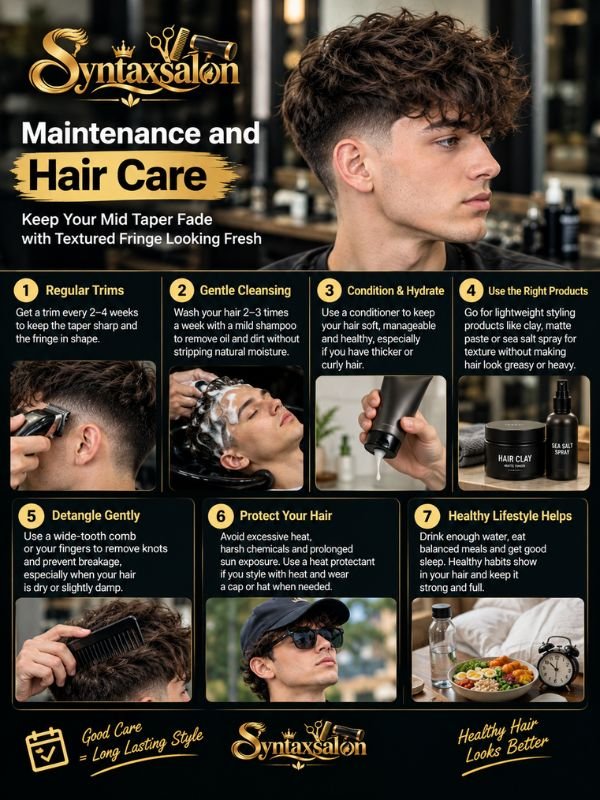
The taper keeps the sides tidy, but the shape softens as hair grows. Many barbers suggest a trim every three to four weeks to keep the sides crisp. You can stretch to five or six weeks if you don’t mind a softer blend. Growth rates differ, so let your own hair set the schedule.
A mid taper fade with textured fringe doesn’t need a complicated routine. Wash with a regular shampoo, rinse out your styling product fully, and add conditioner if the fringe feels dry. If your scalp is flaky, itchy or irritated, see a doctor or dermatologist. Styling can’t fix a scalp problem.
Hair Care Table for Mid Taper Fade
| Step | How often | Why it matters |
|---|---|---|
| Shampoo | As your hair needs it, often every second or third day | Removes oil and product buildup |
| Conditioner | When the fringe feels dry | Keeps texture soft, not frizzy |
| Rinse out product | Every night you’ve styled | Prevents buildup and heavy-looking hair |
| Trim | Every 3–4 weeks | Keeps the taper crisp |
| Heat | Medium setting only | Reduces dryness in the longer top |
| Scalp check | Whenever flaking or itching lasts | Flags a problem worth a professional’s opinion |
Variations of the Mid Taper Fade
Once you know the base cut, you can adjust it:
- Messy fringe: More choppy layers on top and a looser, undone finish.
- Short textured crop: The fringe is trimmed shorter, which suits a low-effort routine.
- Curly fringe: The top keeps its curl pattern while the sides stay clean.
- Blowout taper: The top is left longer and fuller, then blown out for volume.
- Low mid taper: The blend starts a little lower for a softer contrast.
- High taper: The blend starts higher for a sharper, more dramatic look.
- Blonde or colored top: The lighter top stands out against the darker, closer sides.
For a related look with a bolder edge, see related fade haircut guide.
Styling Products to Use
The right product depends on your hair type and how loose or defined you want the fringe. Whatever you pick for your mid taper fade with textured fringe, start with less than you think you need.
| Product | Best for | Finish |
|---|---|---|
| Matte clay | Thick or straight hair | Strong hold, no shine |
| Paste | Most hair types | Flexible hold, slight shine |
| Styling powder | Fine or flat hair | Volume and dry texture |
| Sea salt spray | Straight hair that needs grip | Light, beachy texture |
| Cream | Wavy or curly hair | Soft hold, low shine |
Sea salt sprays can dry hair out, so use them sparingly.
How to Style It Step by Step
- Towel-dry, then leave your hair slightly damp.
- Blow-dry the fringe forward with your fingers, on a medium heat setting.
- Warm a pea-sized amount of product between your palms.
- Work it through from the back toward the front, then twist the ends of the fringe.
- Pinch and separate a few pieces to build texture.
- Add a touch of powder or spray only if it needs more lift.
You can always add more product, but you can’t take it out without washing. For product ideas.
Benefits of This Hairstyle
- Versatile: It works for work, school and casual weekends.
- Low daily effort: A few minutes with product is usually enough.
- Suits many hair types: The right tweaks make it work for straight, wavy and curly hair.
- Grows out gracefully: The taper softens without looking untidy.
- Easy to dress up or down: Push the fringe messy for casual days, or comb it neater for formal ones.
There are a few trade-offs. You’ll need regular trims to keep the sides sharp. The fringe can fall into your eyes on windy days. And if you dislike styling products entirely, you may find the top hard to manage.
Frequently Asked Questions
What fade goes best with a textured fringe?
A mid taper is a safe pick because it balances the messy top without too much contrast. A low taper is softer, while a high taper or mid fade is sharper. Choose by how much contrast you want.
What is a Gen Z haircut?
It’s an informal label with no formal definition. People usually mean relaxed, textured cuts, often a fringe with tapered or faded sides. This style fits that description.
What is a 2 mid fade?
It usually means a mid fade where the shortest point is a #2 guard, about 6 mm. Barbers don’t all use the term the same way, so confirm the length before they start.
What is the most attractive fade?
That’s subjective and depends on your hair type, face shape and personal style. A mid taper works well for many people because it’s balanced and easy to adjust.
How often should I trim a mid taper fade with textured fringe?
Every three to four weeks keeps the sides crisp. If you prefer a softer blend, you can wait five or six weeks.
Conclusion
A mid taper fade with textured fringe works because it balances clean sides with a loose, lived-in top. Bring photos, name the finish you want and ask for texture with scissors. Then match your styling product to your hair type.
Keep up with trims, rinse out your products and give the top as much attention as the fade.